
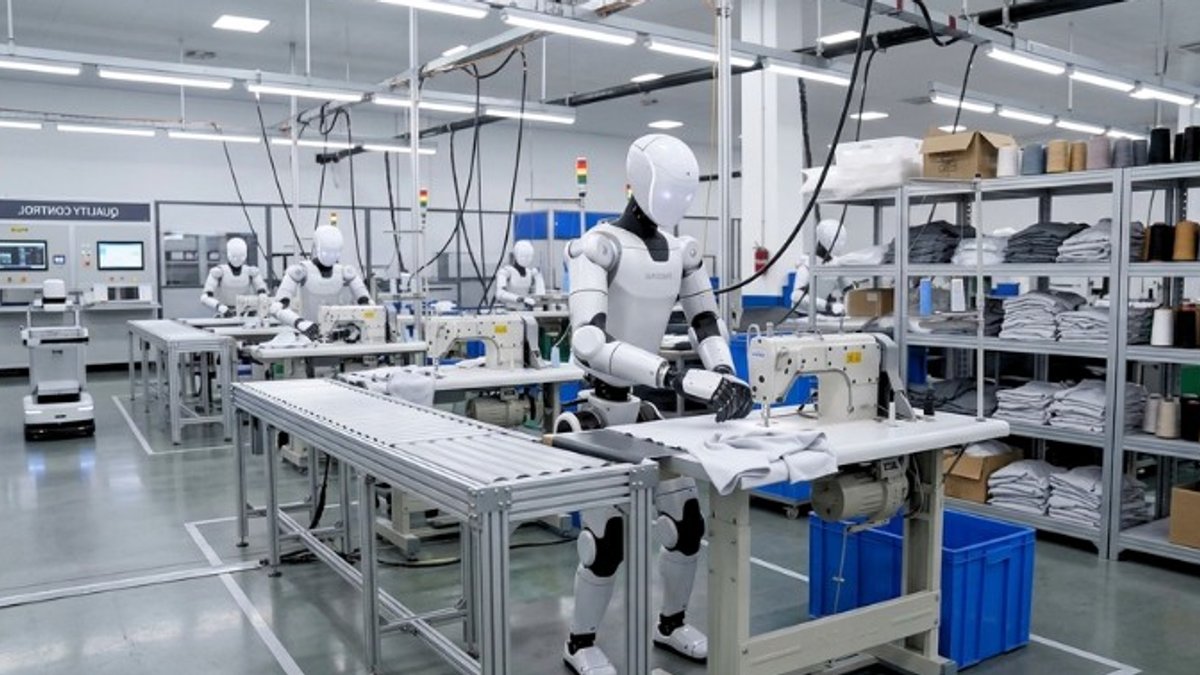
A sewing machine operator in a garment factory in 2023 might have felt uneasy after seeing a viral video of coworkers wearing head-mounted cameras. The footage fueled speculation: would humanoid robots eventually replace sewing workers, just as they are being tested in warehouses and service industries?
Sewing represents the most labor-intensive phase of apparel production, consuming nearly 80% of manufacturing time and employing 80% of factory workers. Yet the process relies on basic human capabilities—precision vision, manual dexterity, and real-time adjustments. Early automation efforts, such as Brother’s BAS 311G and Vetron’s Autoseam (introduced in 2017), attempted to replicate these functions using robotic arms and vision systems. Despite pre-orders for two years in Europe, these systems never achieved widespread adoption.
The core issue was not technical limitations but cost and adaptability. Vetron’s Autoseam operated on rigid X-Y axis movements, suitable only for stiff materials. Modern sewing, however, requires handling stretch fabrics, uneven seams, and dynamic corrections. The technology needed AI-driven adaptability, but it remained underdeveloped when the system launched.
Read Also: Fashion firms launch flexible production network to tackle supply chain
Current discussions now center on humanoid robots, machines designed to replicate human movement, including walking. For sewing, however, mobility is unnecessary. Most tasks, cutting, stitching, ironing, and folding, only demand upper-body precision. Standard six-axis collaborative robots (cobots), like those from Universal Robots or FANUC, already provide the six degrees of freedom required for three-dimensional tool positioning. While these excel at pick-and-place operations, they lack the fine motor control of human hands.
Robotic hands present a partial solution. The average human hand has 27 degrees of freedom, while today’s robotic grippers offer between 11 and 22, delivering near-human dexterity. Even with an advanced gripper, the question persists: does sewing require a full humanoid form? According to a McKinsey report, if we split a humanoid robot, the cost of the upper body, lower body, and the shared platform comes to approximately 42%, 47%, and 11% respectively. So, an upper-body-only system with precise hands could perform sewing operations at approximately 50% of the cost of a humanoid robot!
The debate now focuses less on whether humanoid robots can sew and more on whether they represent the optimal solution. In an industry where labor costs dominate expenses, the discussion shifts from technological capability to cost efficiency and problem-solving.