
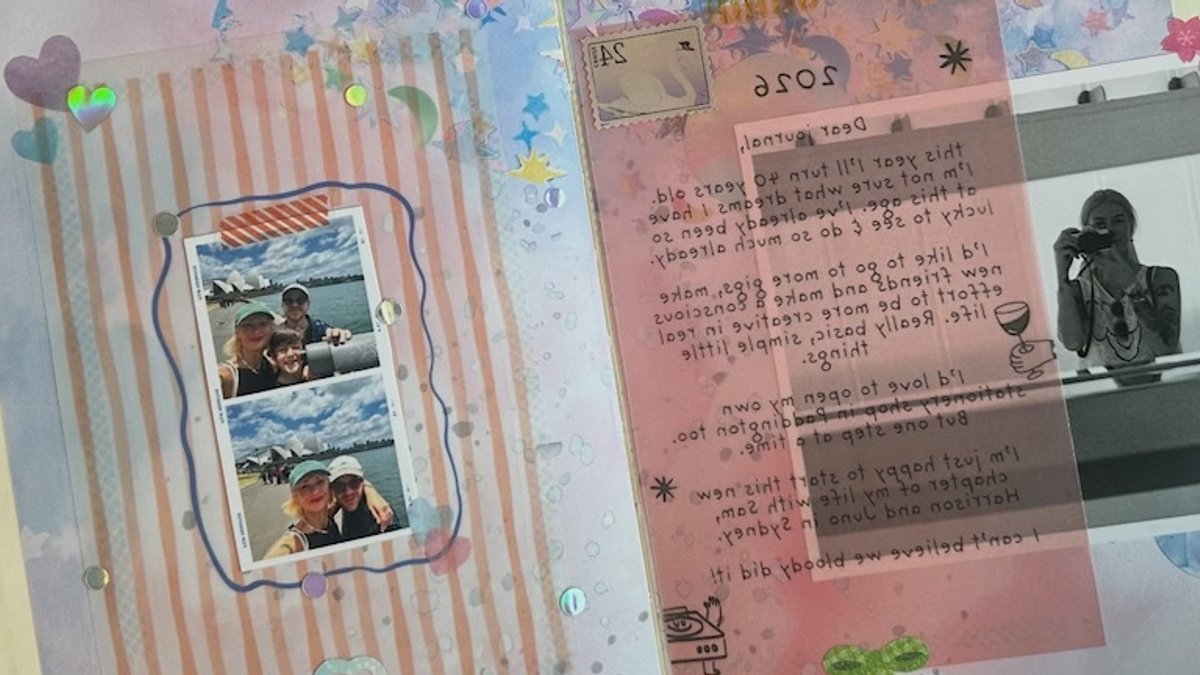
A blank journal page can feel like both an opportunity and a source of anxiety. Many people rush to buy a new Midori notebook from The Hub General Store in Collingwood, driven by the hope of self-improvement, only to end up filling its pages with complaints rather than meaningful reflections. The result is a collection of frustrations instead of memories worth revisiting.
Junk journaling provides an alternative approach. Unlike traditional diaries focused on introspection, it centers on curation—transforming moments into tangible keepsakes through tickets, magazine cutouts, and other ephemera. For Elle Judge, a Sydney-based creative who has practiced junk journaling since her teenage years, it serves as a way to preserve fleeting experiences. She turned this habit into Shell Flower, an online store specializing in stationery and journals. “It’s a beautiful way to capture a moment on paper,” she explains. “You can look back and relive it.”
Crafting moments with tangible keepsakes
The method’s appeal lies in its physical nature. In an era dominated by passive screen consumption, junk journaling demands active engagement—cutting, gluing, and layering materials. “Did you meet a friend after months apart?” she suggests. “Save the receipt.” Visiting an exhibition? Tuck in the flyer. The guiding principle is simple: if an item sparks joy or nostalgia, it belongs in the journal.
Read Also: Similar Nostalgic Fashion Labels to Sandy Liang
Beginning requires minimal supplies. Judge recommends a sturdy journal, such as the Leuchtturm 1917 A5 hardback, along with basic tools like glue, scissors, and household scraps. The true value emerges during the creative process. “Don’t overcomplicate it,” she advises. “Buy what you love, stick to what feels like you.”
Time constraints often disrupt journaling routines. Judge acknowledges she once filled pages daily but now struggles with consistency due to life’s demands. However, even dedicating an hour to a spread can serve as a mental reset, allowing a break from daily stresses. The beauty of junk journaling lies in its flexibility; there are no rules, no deadlines, and no pressure to create something perfect. The journal waits patiently until its creator is ready.
A blank page can feel intimidating, particularly when the pressure to create something flawless sets in. Judge’s solution is straightforward: start with an “about me” page. Use stickers spelling your name, include a photo, or list favorite songs or coffee orders. “It’s your world,” she says. “Play around. If you’re unsure, lay out the pieces first. Move them. See what feels best.”
From scraps to intentional archives
The tactile nature of journaling, holding paper, cutting shapes, and arranging layers, creates a deliberate contrast to digital life. Stores like Made590 in Sydney’s Marrickville and Melbourne’s The Paper Joint offer inspiration, stocking everything from Japanese stationery to beginner workshops. Judge’s own journaling journey began with simple scraps: concert set lists, fashion magazine clippings, and hand-drawn doodles. “It’s not about the tools,” she emphasizes. “It’s about the moments you choose to preserve.”
Read Also: Seven Australian Authors on Books That Changed Their Lives
Even digital items, once limited to physical formats, can now be printed on request. Museum visits yield postcards from gift shops, while photobooth sessions provide silly strips to include. The core principle remains: let the journal reflect your life, not an imposed ideal of how it should appear.
For those hesitant to commit materials to paper, Judge recommends experimentation. Arrange elements on a flat surface before gluing them down. Begin with a central image or bold background to spark ideas. The goal isn’t to create a masterpiece but to build a personal archive of meaningful details that might otherwise be forgotten.
Judge’s journaling process blends spontaneity with intention. A receipt from a café where she reunited with an old friend might share space with a torn page from a beloved book or a Polaroid from an unplanned road trip. The method prioritizes preserving fragments that define moments over strict chronology. “It’s not about the tools,” she repeats. “It’s about the moments you choose to preserve.”